Art Puzzles for Adults: How to Choose a Masterpiece You’ll Want to Frame
Choosing an art puzzle is not quite the same as choosing a painting for a wall.
A painting is experienced as a complete image. A puzzle reveals itself in fragments - a face before a figure, a colour before a landscape, a single brushstroke before the story becomes clear.
That difference matters.
The best art puzzles for adults succeed in three forms:
- As an artwork you feel drawn to
- As an engaging 1000-piece building experience
- As a finished object you would be proud to preserve and display
A famous painting is not automatically a satisfying puzzle. Likewise, an unfamiliar work can become unforgettable when its colours, textures and hidden details are discovered piece by piece.
This guide explains how to choose an art puzzle by composition, colour, difficulty, mood and display potential - not simply by the name of the artist.
What is an art puzzle?
An art puzzle uses a painting, illustration or original artwork as its complete image.
Unlike a conventional scenic puzzle, an artist puzzle invites you to spend time with the decisions behind the work: the palette, composition, gestures, symbols, textures and relationships between different parts of the image.
A museum art puzzle may reproduce a recognised masterpiece by Vincent van Gogh, Claude Monet or John William Waterhouse. A contemporary artist puzzle may introduce a work you have never encountered before.
Both can create a meaningful experience. The more important question is whether the artwork remains interesting when separated into hundreds of individual fragments.
The three lives of an art puzzle
1. The first impression
Would the image immediately attract your attention when you opened the set?
This initial response is emotional. You might be drawn to a colour, face, landscape, atmosphere or memory before knowing anything about the artwork.
Do not dismiss that instinct. Art often reaches us before we can explain why.
2. The building experience
Once the image is divided into 1000 pieces, does it still provide enough visual information to guide you?
Distinctive colours, visible textures, recognisable figures and directional lines create useful landmarks. Large areas of nearly identical colour create a more demanding experience.
Neither is inherently better. The right choice depends on whether you want a calm, flowing build or a prolonged visual challenge.
3. The finished artwork
After completing it, would you want to see the image again?
A frameable puzzle needs more than short-term novelty. It should have enough emotional or decorative value to remain meaningful after the final piece is placed.
At DAILE, we call this the gallery-to-wall test: would the artwork still deserve space in your home if you had not assembled it yourself?
1. Begin with the feeling, not the artist’s name
Many people begin by searching for a familiar artist. That can be a good starting point, but it should not be the only one.
Instead, ask how you want the completed artwork to make the room feel.
For a calm and restorative atmosphere
Look for soft light, natural colours, open space and gentle transitions.
Garden scenes, quiet interiors, water, flowers and Nordic landscapes can create an unhurried experience. Works such as Claude Monet’s Water Lilies or Carl Holsøe’s Interior, Light of Spring invite close attention without overwhelming the eye.
For energy and emotional intensity
Choose expressive lines, dramatic contrast and visible movement.
Swirling skies, unusual perspectives and concentrated colour can make every section feel active. Vincent van Gogh’s The Starry Night is an example of an artwork in which movement connects almost every part of the image.
For romance and quiet intimacy
Look for figures, flowers, enclosed gardens, symbolic gestures and softer palettes.
John William Waterhouse’s The Soul of the Rose combines a recognisable figure with architectural lines, fabric, flowers and subtle changes of tone.
For a sense of place
Choose an artwork connected to a city, landscape, season or home.
A work such as Karine Paronyanc’s Once Upon a Time in Riga or Amalija Andersone’s Latvian Summer series can carry personal meaning for someone who remembers Latvia, lives abroad or associates a particular landscape with home.
For symbolism and reflection
Consider contemporary works whose meaning develops gradually.
Stazi Li’s Yin-Yang Horses, for example, can be approached both as an equestrian image and as a visual study of balance, opposition and movement.
The artwork does not need to match the room perfectly. It should create the emotional presence you want the room to hold.
2. Read the composition as a map
A puzzle solver does not initially see a complete painting. They see hundreds of fragments looking for relationships.
Composition becomes the map.
Before choosing an artwork, identify its visual landmarks. These may include:
- A clearly defined face or figure
- Architectural edges
- A horizon
- Repeated flowers or leaves
- A distinctive piece of clothing
- Strong changes between light and shadow
- Curved lines or visible brushstrokes
- Objects with unique colours
- Areas of ornament
- Animals with recognisable outlines
An artwork with several landmarks offers multiple places to begin. One person may assemble the figure while another works on the sky, flowers or architecture.
An image with only one focal point and a vast uniform background will usually feel more difficult, even when the complete picture appears simple.
3. Look at colour before looking at subject
Colour strongly affects how an art puzzle feels to assemble.
Imagine two paintings of the same garden. The first has clearly separated areas of green foliage, blue sky, pink flowers and pale architecture. The second is painted almost entirely in similar shades of green.
Both may be beautiful. The first will usually provide clearer visual categories. The second will require closer attention to small tonal differences and brushwork.
Choose a varied palette when:
- You are newer to 1000-piece puzzles
- Several people will assemble it together
- You enjoy sorting pieces by colour
- You want to see progress relatively quickly
- The puzzle is intended as a gift for someone whose experience level is unknown
Choose a limited palette when:
- You enjoy subtle visual distinctions
- You prefer a longer challenge
- You are comfortable sorting by texture and shape
- The artwork has emotional or decorative importance beyond its difficulty
- You enjoy returning to the puzzle over multiple evenings
Colour variety does not necessarily mean bright colour. A muted painting can still contain many distinguishable areas through changes in temperature, value and texture.
4. Understand how different art styles affect difficulty
The number of pieces is only one part of puzzle difficulty. Painting style can matter just as much.
Realism and figurative painting
Recognisable people, animals, buildings and objects create clear reference points. Fabric, faces, furniture and architecture can be separated into meaningful sections. However, detailed crowds or highly intricate interiors can still become challenging.
Best for: solvers who enjoy recognising objects and gradually reconstructing a scene.
Impressionism
Impressionist works often combine recognisable subjects with loose edges and visible colour transitions. Up close, individual fragments may appear abstract. From a distance, they become water, sky, foliage or light.
Best for: solvers who enjoy colour and atmosphere more than precise outlines.
Expressionism
Strong lines, exaggerated forms and contrasting colour can provide excellent visual clues. The challenge often comes from repeated movement across the image rather than a lack of information.
Best for: energetic builds and people drawn to emotionally intense art.
Pointillism
Pointillist works contain countless small colour relationships. An image such as Georges Seurat’s A Sunday on La Grande Jatte offers many figures and objects, but its dotted surface can make individual pieces surprisingly complex.
Best for: patient solvers who enjoy fine colour distinctions and detailed scenes.
Floral and botanical art
Flowers create attractive colour zones, but repeated petals and leaves can increase difficulty. A floral still life with a clearly defined vase, background and table will generally provide more structure than an image filled entirely with similar blossoms.
Best for: calm, decorative builds with moderate visual repetition.
Abstract art
Abstract work removes familiar objects as guides. You may need to rely on shape, line direction, colour and texture alone. Bold geometric abstraction can be highly structured, while soft tonal abstraction may be extremely demanding.
Best for: experienced solvers and people who genuinely love the artwork independent of the subject.
Art Deco and graphic illustration
Strong geometry, defined silhouettes and repeated decorative patterns can make sorting intuitive. Fine ornamental repetition may create difficulty later in the build.
Best for: design-minded interiors and solvers who enjoy strong visual structure.
5. Use the slow-looking test
An artwork should offer more than an immediate visual impact.
Open the image at a large size and spend several uninterrupted minutes looking at it. Do not read the title or artist biography yet.
Notice:
- Where your eye goes first
- Which detail you discover second
- How the composition directs your attention
- Whether the background contains anything unexpected
- Which colours repeat across the image
- Whether the mood changes as you continue looking
- Which section you would want to assemble first
Then ask one important question:
Did the artwork become more interesting after several minutes?
If the answer is yes, it will probably reward the extended attention required by a 1000-piece puzzle.
If the image feels exhausted after the first glance, it may work better as a poster than as an immersive building experience.
6. Decide between a famous masterpiece and a contemporary artist
There is no single correct choice.
Choose a famous painting puzzle when:
- The recipient already loves a particular artist
- You want a recognisable museum-inspired gift
- The painting has personal or cultural meaning
- You enjoy discovering familiar imagery at a much closer scale
- The finished piece will join an existing art collection
The DAILE Classics collection includes recognised works selected for both artistic importance and their potential as engaging 1000-piece builds.
Choose a contemporary artist puzzle when:
- You want to discover an artwork outside the most reproduced museum canon
- You value a direct connection to a living artist
- The recipient enjoys collecting emerging or regional art
- The story behind the work is part of the experience
- You want the finished piece to feel less familiar and more personal
The DAILE x Artist collection brings together works by contemporary creators, including artists connected to Latvia and the wider European art scene.
A masterpiece carries cultural recognition. A contemporary work can create discovery. Both can become meaningful when the image speaks to the person assembling it.
7. Consider authorship and the story behind the image
An artwork becomes richer when you know why it exists.
Who created it? What was happening in the artist’s life? What visual traditions influenced it? Is the subject literal, symbolic or autobiographical? Why did the artist choose this palette, location or figure?
This context should not dictate what you are allowed to see. It should give you additional ways to enter the work.
DAILE art sets include artist and story cards, while the integrated NFC micro-book provides further context about the artwork and its creator.
The physical act of assembly and the digital story support each other:
- The puzzle encourages prolonged visual attention
- The story explains details you may otherwise overlook
- The finished artwork keeps the experience present in the home
The result is not simply information placed beside a product. It is a deeper relationship with the image.
8. Think about where the completed artwork will live
Before selecting a puzzle, imagine the completed piece in a real room.
Consider:
- The colours already present in the space
- The amount of natural light
- The size of the available wall
- Whether the room feels calm, graphic, romantic or eclectic
- The other artworks nearby
- Whether the image should blend in or become a focal point
A colourful expressionist work may energise a restrained room. A quiet interior may soften a visually busy space. A floral painting can bring warmth without requiring a literal botanical interior.
Do not try to match every colour exactly. Art often becomes more powerful when it creates a considered contrast.
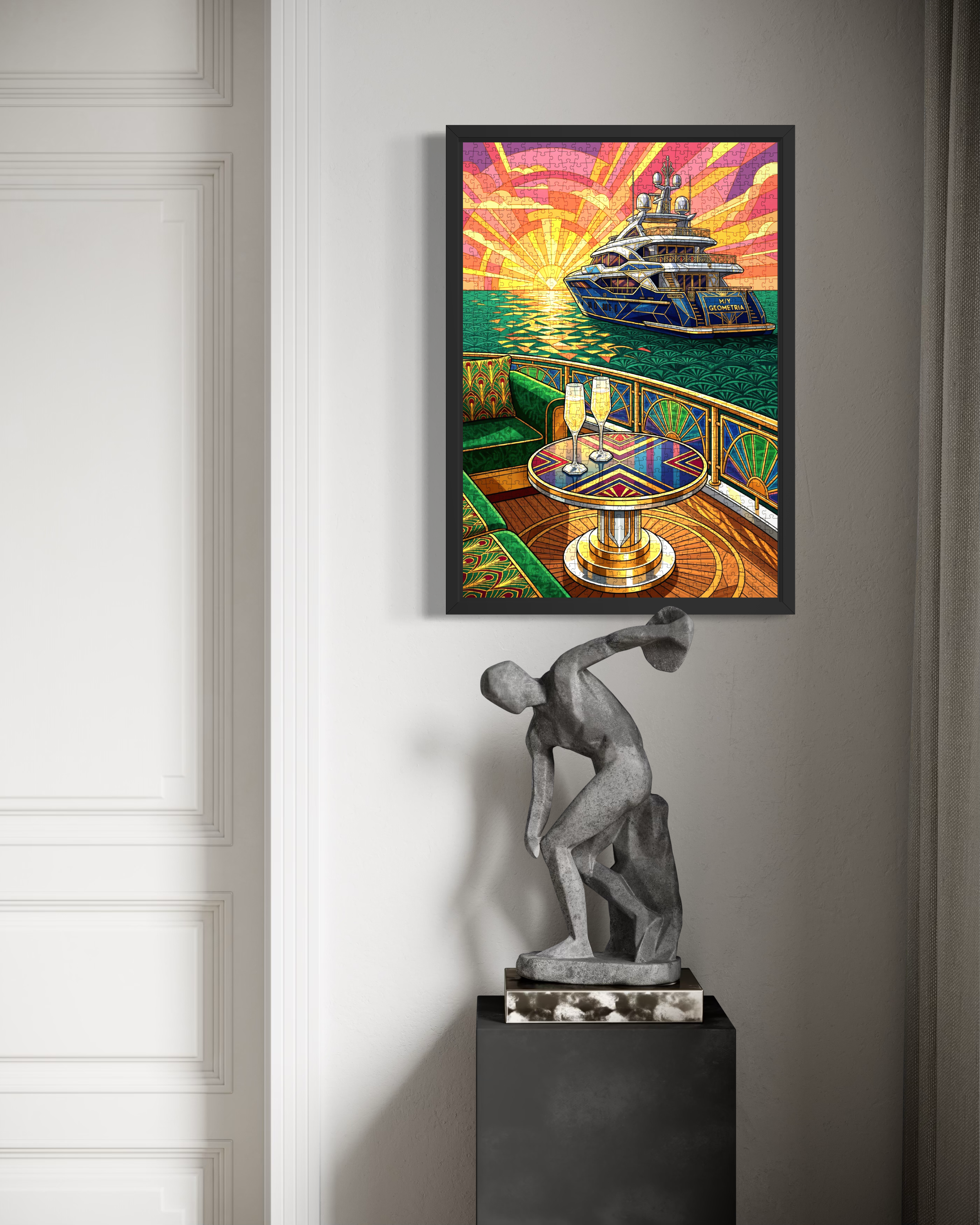
The DAILE 1000-piece format finishes at approximately 45 x 65 cm, making it substantial enough to read as wall art while remaining suitable for many home interiors.
9. Choose the right difficulty for the person
A beautiful gift can become frustrating when the challenge is poorly matched to the recipient.
A more approachable art puzzle often includes:
- Several strong colour zones
- Recognisable figures or objects
- Clear architectural lines
- Varied textures
- A distinct foreground and background
- Limited areas of uniform colour
A more difficult art puzzle often includes:
- Large gradients
- Repeated flowers, waves or foliage
- Similar tones across most of the image
- Soft or indistinct edges
- Dense pointillist detail
- Minimal or abstract composition
- Dark areas with few visible landmarks
For a first 1000-piece art puzzle, choose an artwork that combines emotional appeal with visible structure.
For an experienced solver, subtle colour, repeated brushwork and complex atmosphere can become part of the pleasure.
10. Look beyond the image itself
A premium art puzzle should respect the artwork throughout the entire experience.
Image reproduction
Colour, contrast and detail should allow the painting to remain legible at puzzle scale. Important textures should not disappear into blocked shadows or excessive saturation.
Piece quality
Pieces should feel substantial, connect cleanly and remain comfortable to handle through a long assembly.
Presentation
The packaging should protect the object and create an appropriate introduction to the artwork.
Context
The artist should be identified clearly. The story should be treated as part of the work rather than decorative marketing.
The afterlife of the puzzle
A completed art puzzle should have a clear next step: rebuild it, preserve it or display it.
Every DAILE art set is created as a complete sequence:
Open. Assemble. Discover. Preserve. Display.
Depending on the edition, the experience can include a signature bamboo capsule for the pieces, a concrete candle, puzzle glue, an applicator card, a microfibre cloth, artist and artwork cards, and an NFC micro-book.
These elements are not intended to compete with the artwork. They create the conditions for spending meaningful time with it.
Why 1000 pieces work particularly well for art
A 1000-piece format provides enough scale for small artistic decisions to become visible.
A brushstroke that disappears in a thumbnail becomes an entire group of pieces. A background figure becomes its own discovery. A colour repeated subtly across the painting can connect distant areas of the composition.
At the same time, the format remains suitable for a table and can be completed across a series of evenings without becoming a permanent installation.
For many adults, 1000 pieces create a useful balance:
- Long enough to feel immersive
- Detailed enough to reward close looking
- Substantial enough to complete with another person
- Large enough to become decorative wall art
- Manageable enough to preserve and frame at home
The best difficulty is not the one that takes the longest. It is the one that keeps you curious.
The DAILE gallery-to-wall checklist
Before choosing an art puzzle, answer these questions:
- Would I be interested in this artwork even if it were not a puzzle?
- Does the image become more interesting the longer I look at it?
- Can I identify several useful colour, texture or object landmarks?
- Does the difficulty match the person who will assemble it?
- Is the artist or origin of the artwork clearly presented?
- Does the palette create the mood I want?
- Would the completed image suit a real place in the home?
- Would I still want to see it after the final piece is placed?
When most answers are yes, you are not simply choosing an activity. You are choosing an artwork you will gradually come to know.
Frequently asked questions
What are the best art puzzles for adults?
The best art puzzles combine an image you genuinely enjoy with enough variation in colour, texture and composition to remain engaging across the full build. The ideal choice depends on personal taste and desired difficulty rather than the fame of the artwork alone.
Are 1000-piece art puzzles suitable for beginners?
Yes, provided the artwork contains clear visual landmarks and varied colour areas. Beginners may prefer figurative works, architecture, strong silhouettes or distinct foreground and background sections.
Which paintings make the easiest puzzles?
Paintings with clearly separated subjects, contrasting colours, defined edges and multiple recognisable objects tend to be more approachable. However, the exact cut and reproduction also affect difficulty.
Which art styles make the most difficult puzzles?
Minimal abstraction, limited palettes, large gradients, repeated foliage and soft Impressionist passages can be challenging because individual pieces provide fewer obvious clues.
Can a completed art puzzle be framed?
Yes. After checking that every piece is correctly placed, the puzzle can be secured with suitable puzzle glue and mounted or framed. Always follow the adhesive and frame instructions for the specific product.
Are famous painting puzzles good gifts?
They can be excellent gifts for art lovers, museum visitors and people who already connect with a particular artist. The most thoughtful choice relates the painting’s mood, subject or story to the recipient.
What is the difference between an art puzzle and a normal puzzle?
An art puzzle is designed around an artwork and its authorship. Its value comes not only from solving the image but also from engaging with the artist’s composition, ideas and visual language.
Should I choose classic or contemporary art?
Choose classic art for recognition, cultural context and familiar masterpieces. Choose contemporary art for discovery, direct artist connection and a finished piece that may feel less expected. The strongest choice is the work you want to keep looking at.
Choose art that rewards your attention
An art puzzle asks something unusual of us.
It takes an image that can normally be consumed in seconds and turns it into an experience measured in evenings. It replaces scrolling with observation. It allows colour, line and meaning to arrive gradually.
By the time the artwork is complete, you have not simply seen it.
You have held every part of it.
Choose a painting that invites curiosity, matches the experience you want and deserves a place beyond the puzzle table.