Digital Art Story
The Soul of the Rose
by John William Waterhouse
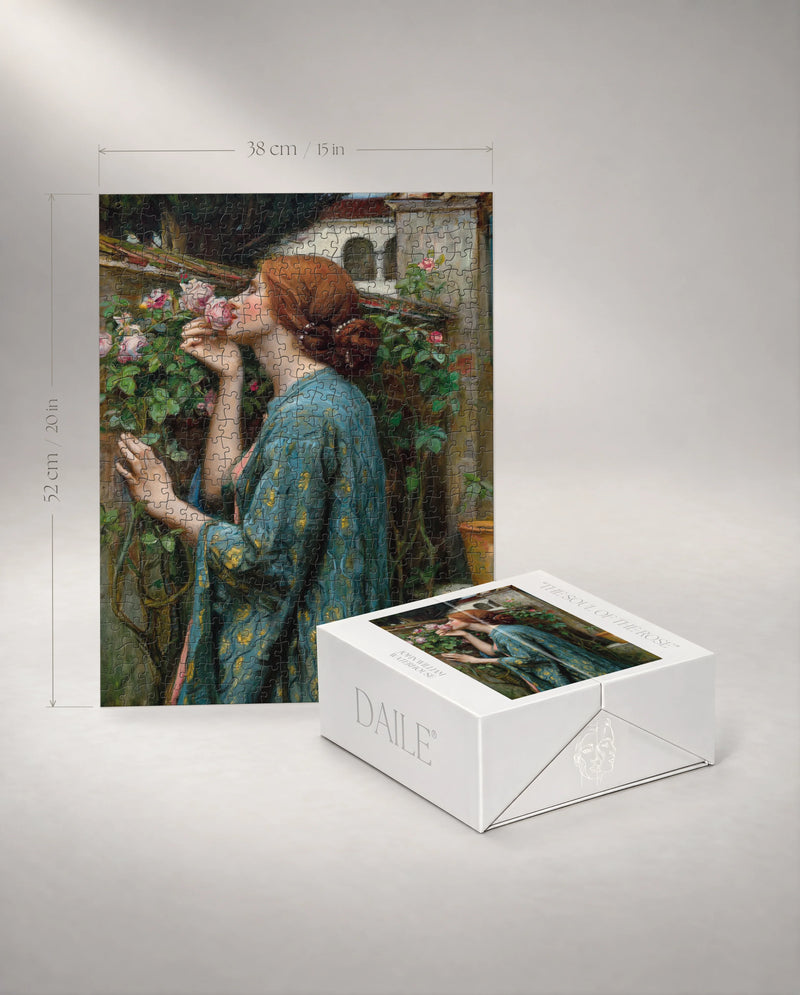
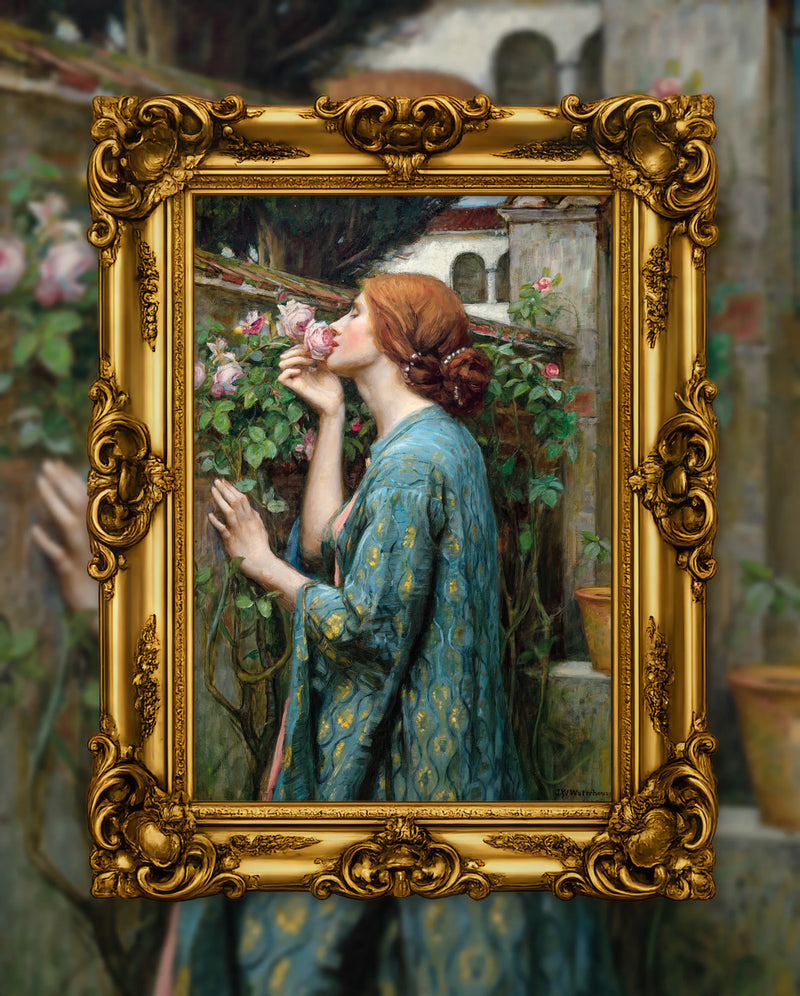
A young woman with auburn hair, dressed in a patterned blue-green gown, leans towards a climbing rose that spills over a brick wall. Eyes closed, she cups the flower gently, inhaling its scent. Behind her, an elegant house, tiled roof and dark cypress tree suggest a secluded garden court. The whole scene is bathed in soft, warm light, turning a simple gesture into something intimate and timeless.
About the work
“The Soul of the Rose” captures a moment so small it could be missed: a woman stopping to breathe in the scent of a single flower. Yet Waterhouse paints it as an entire inner world. The figure presses close to the rose, eyes softly shut, as if listening to something only she can hear. The architecture and garden around her fade into a quiet backdrop; what matters is the contact between skin and petals, memory and perfume.
The title and mood reflect Tennyson’s line from Maud — “the soul of the rose went into my blood” — and the painting visualises that idea: the moment when an external sensation becomes an internal feeling. The medieval-style dress, the enclosed garden and the distant house suggest nostalgia and separation, hinting that the rose may stand in for a loved one, a lost time, or a promise that cannot be fully reached.
Rather than illustrating the entire narrative of the poem, Waterhouse condenses its romantic longing into one gesture. It is about pausing in the doorway between outer world and inner emotion, knowing that a single breath can awaken a whole history of desire, memory and sweetness.
Good to know
- Original 1908 oil painting by John William Waterhouse, private collection
- Alternative title: “My Sweet Rose”
- Literary reference: inspired by Alfred, Lord Tennyson’s poem Maud (“And the soul of the rose went into my blood”)
- Hallmarks of Waterhouse’s mature style: Pre-Raphaelite romanticism, rich colour, focus on a solitary female figure, blend of precise detail and soft atmosphere

The artist
John William Waterhouse
1908, England
Waterhouse bridged Academic painting and the later wave of Pre-Raphaelite romanticism. His canvases often centre on a single young woman in a moment of inward intensity – pausing, listening, longing, or standing on the edge of choice. Literary sources such as Homer, Shakespeare and Alfred, Lord Tennyson fed his imagination, and he translated their emotional peaks into images filled with texture, symbolism and a soft, almost musical handling of light and colour.
When a single breath becomes a love story
In “The Soul of the Rose”, nothing “dramatic” happens – and that is exactly why it feels so powerful. A woman leans into a climbing rose, closing her eyes as the scent rises. For a heartbeat, the world behind her – house, stone, sky – disappears. Waterhouse paints that tiny pause as a whole universe of emotion: longing, remembrance, the sweetness and ache of loving something (or someone) you cannot fully hold.
Like Tennyson’s verse, the painting suggests that beauty does not just surround us; it moves through us, enters our blood, colours how we remember a place or a person. This is not simply a picture of a woman and a flower. It is a portrait of what happens inside us when we finally stop and let a moment touch us completely.
From Table to Wall — Quick Guide
Unbox & Prepare
Clear a calm surface, soft light, and a cup of tea.
Build Anchors
Start with edges and key color islands.
Finish & Mount
Glue it, frame it, hang it on the wall.
Tip: Classic and Signature come with a glue & display kit to frame and hang your finished picture.