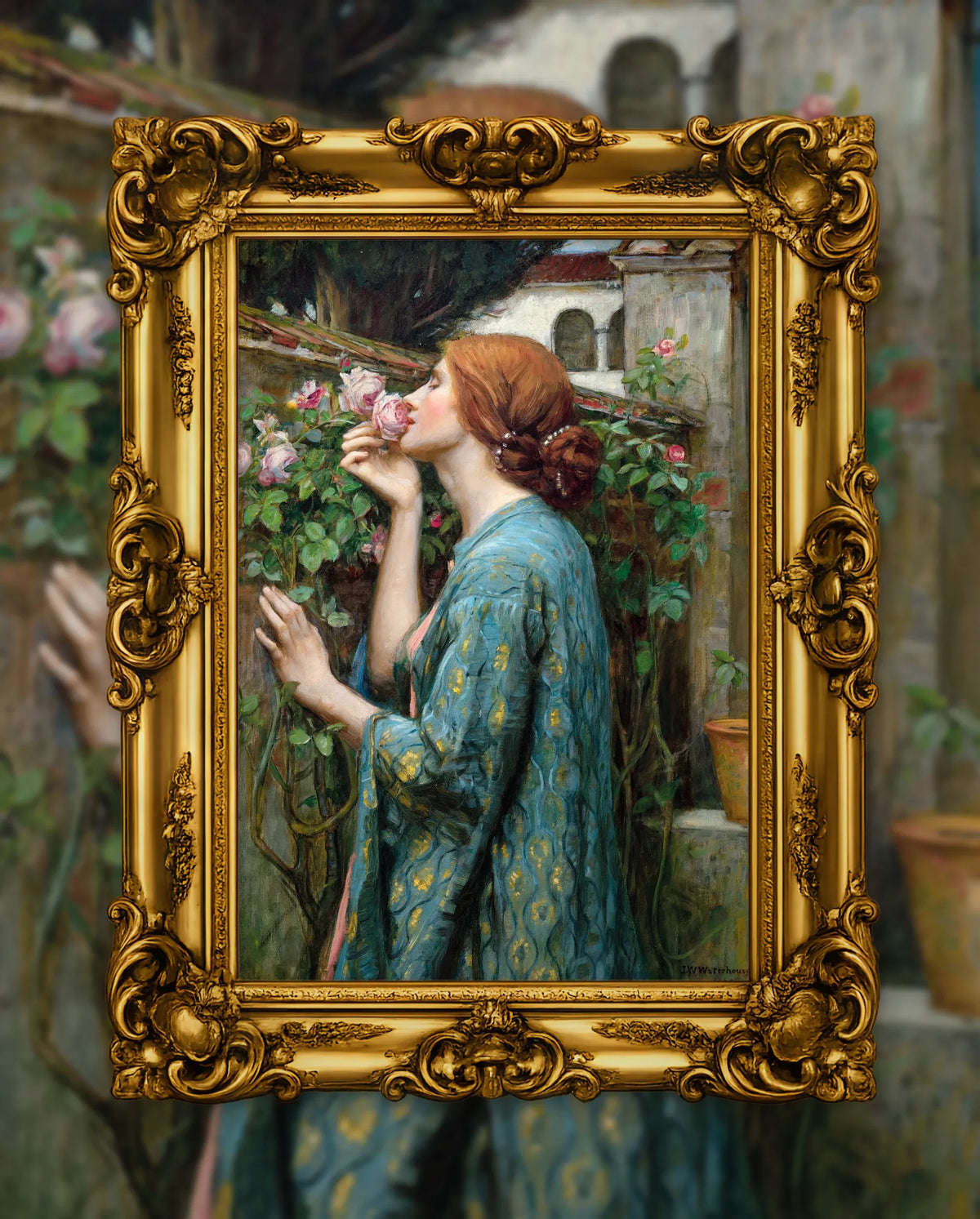
She is alone in a garden, leaning towards a rose. There is no letter in her hand, no figure waiting by a gate, no dramatic gesture. Yet the painting seems full of something about to be remembered.
John William Waterhouse's The Soul of the Rose (1908), sometimes called My Sweet Rose, shows a young woman drawing close to a flower. It is an intimate image in which an ordinary sensory detail seems to become an entire private world.
What does The Soul of the Rose mean? The painting is commonly interpreted as an image of romantic longing, memory and the emotional power of scent. It draws on Alfred, Lord Tennyson's poem Maud, and Waterhouse's garden scene turns a poetic idea into one quietly absorbed moment. This is an interpretation of the artwork, not a single definitive explanation.
A love story told without lovers
Waterhouse leaves most of the narrative outside the frame. The woman closes her eyes as she leans into the rose. Stone, foliage and architecture surround her, but the flower is the emotional centre.
That restraint matters. A grand declaration could pin the painting to one story. Instead, the gesture invites viewers to supply their own memory: someone they miss, a garden they knew, a particular day when a scent brought the past suddenly close.
Why the title refers to poetry
The painting's title is associated with Tennyson's Maud, a poem that entwines the natural world with love and feeling. Rather than reproduce a whole literary episode, Waterhouse isolates an impression: the moment in which something outside us touches an inner memory.
Waterhouse (1849–1917) worked in a romantic figurative tradition often linked to later Pre-Raphaelite painting. His subjects frequently draw on myth, literature and solitary moments of heightened emotion. In this picture, he creates drama without movement.
Look at the image in three passes
- First, the gesture: Notice the face turned towards the flower and the absence of any audience within the scene.
- Second, the enclosure: The wall and garden create privacy, making the sensory moment feel unusually concentrated.
- Third, the memory: Ask what the flower might represent to someone who is not present in the painting.
Looking this slowly is one reason figurative paintings can feel so different on a wall than as a quick image on a phone. The viewer gets to invent the questions before searching for answers.
Why it makes a distinctive gift for a romantic art lover
A rose bouquet is a lovely gesture, but it has an obvious meaning. Waterhouse's painting offers a subtler gift: beauty that leaves interpretation open. It can suit a partner who loves Pre-Raphaelite painting, a reader of English poetry, someone who grows roses, or a person who prefers thoughtful objects over dramatic gestures.
DAILE offers The Soul of the Rose as a fine art jigsaw puzzle, allowing a recipient to explore the image piece by piece. The art sets include a Digital Art Story accessed via NFC, and the 1,000-piece Classic and Signature formats include tools for preserving the completed artwork.
Don't choose it merely because you are shopping for a woman or a Valentine's present. Choose it for someone who appreciates the image's quiet language.
How to present the painting as a gift
Write one sentence about why you chose this particular image. Maybe the recipient grows roses, loves the poetry of Tennyson, or once spoke about a garden that made them happy. If the gift carries a story, tell it without trying to explain what they must feel.
For someone who is not a puzzle enthusiast, a print, exhibition book or museum visit may be more suitable. A good gift starts with the person, not a fixed format.
Frequently asked questions
Who painted The Soul of the Rose?
John William Waterhouse painted The Soul of the Rose in 1908. It is also known as My Sweet Rose.
What poem inspired The Soul of the Rose?
Its title and romantic mood are connected to Alfred, Lord Tennyson's poem Maud.
Is The Soul of the Rose a romantic gift?
It can be, particularly for people interested in romantic painting, gardens or poetry. It is thoughtful because the imagery leaves room for personal memory, rather than delivering a generic love message.
Explore the artwork in DAILE's Digital Art Story, then choose an art puzzle gift format if the recipient would enjoy making the painting themselves.